

- Quelle: Archiv Frau und Musik
- Gemeinfrei
And they played, sang, composed, and conducted: the long-ignored women in music!
Canonical Historiography and Reality
“Let your women keep silent in the churches.”1 Despite this sweeping dictum in an epistle attributed (likely erroneously) to Paul the Apostle, it did not keep women from playing instruments, composing, teaching, and promoting music, administering musical estates, building musical instruments, or speaking and writing about music. Well into the twentieth century, however, they generally had no opportunities to appear in public or hold paid positions in the government, church, and civic cultural institutions. Women were scarcely mentioned at all in musical historiography.
On Singing Abbesses, Troubadours, and Instrumentalists …
Abbess and poet Kassia of Constantinople (c. 810–865) is considered the earliest known female composer in the Western world. She founded her own women’s community and left roughly fifty hymns to posterity. It can be assumed, however, that other women composed music as well, both earlier and around the same time as her, although no evidence of them has survived. Music was not generally put into written form until around 800 CE, and the attribution and naming of authors did not happen until much later.2 This refers only to spiritual music, since reading and writing and especially musical notation skills were taught to women only in convents and nunneries—if at all.3 In the German-speaking realm, Hildegard von Bingen (1098–1179) was significant, for example. Her music and her visions were both disturbing and inspiring. Magistra Tengswich of the House of Canonesses of St. Mary in Andernach wrote a letter to Hildegard criticizing that “[t]hey say on feast days your virgins stand in the church with unbound hair when singing the psalms and that as part of their dress they wear white, silk veils, so long that they touch the floor.”4 Hildegard research was already underway around 1900 and was boosted through research on women’s music starting in the 1970s and the celebrations of Hildegard’s 900th birthday in 1998.5
Numerous women in the Middle Ages were active in the field of secular music as trobairitz or troubadours at Portuguese, Spanish, and French courts, such as Beatriz de Dia (born after 1140–c. 11896) and Azalaïs de Porcairagues (dates of birth and death unknown). There were also minstrels—goliards, musicians, and balladmongers—who earned their money with music or as dancers. Often, they were alleged to be prostitutes. In fifteenth- and sixteenth-century Italy, there were major centers for music by women in Ferrara and Mantua, where the early baroque composers Francesca Caccini (1587–after May 1641), Barbara Strozzi (1619–1677), and Maddalena Casulana (c. 1544–death unknown) lived and worked, as well as the concerti delle donne, or women’s ensembles, which for the first time brought the “reborn” (Greek) affetti (feelings), such as love, hatred, and grief, to the stage. They were also singers, instrumentalists, and composers in one, hired by courts, and they pioneered a new art form: opera.
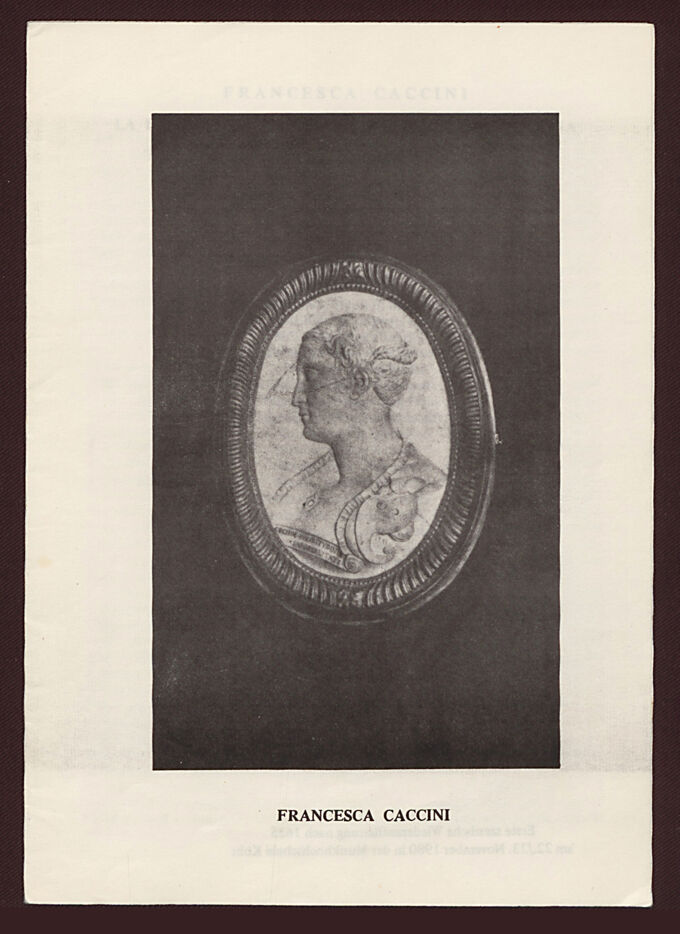
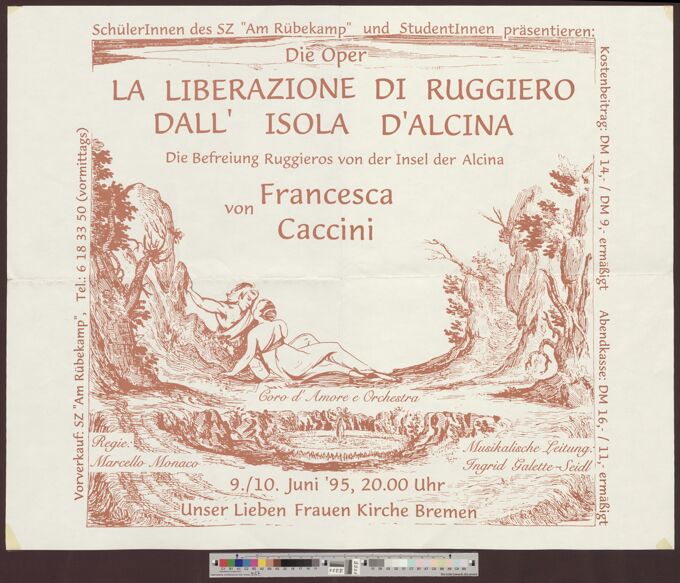
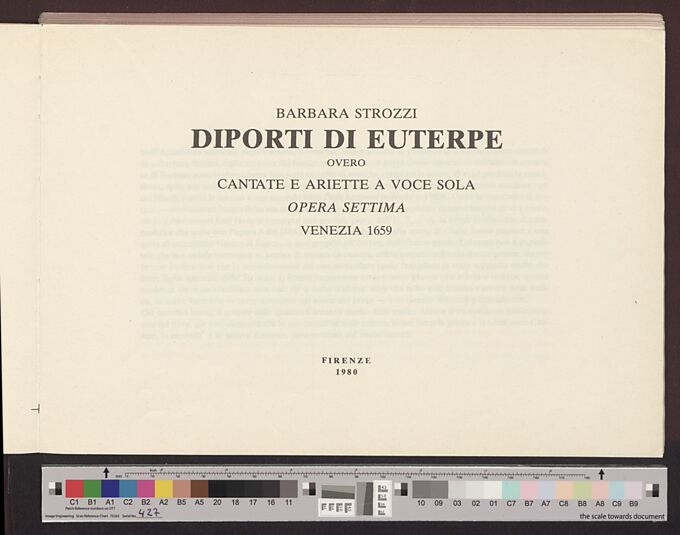
… Noble Collectors, Patrons, Opera House Founders, and Musical Event Organizers …
During the Enlightenment, noble women in particular were able to work creatively. Anna Amalia of Prussia (1723–1787), a sister of Friedrich II of Prussia (1712–1786), for example, composed and played music, and assembled a music library with works by Johann Sebastian Bach (1685–1750) and his sons and contemporaries. Her sister, Wilhelmine (1709–1758), was also a composer and had an opera house built in Bayreuth (today a UNESCO world cultural heritage site). The libretto and composition of the opera Talestri, Queen of the Amazons, from the pen of Maria Antonia Walpurgis of Saxony (1724–1780), broke with traditional gender roles. Caccini’s opera La liberazione di Ruggiero dall‘isola d’Alcina also focusses on the major, powerful women’s roles.7
Anna Amalia, Duchess of Saxe-Weimar-Eisenach (1739–1807), was also a composer, cembalist, and patron. She gathered a circle of poets and scholars around her—the Weimar Courtyard of the Muses—including Johann Wolfgang von Goethe (1749–1832), Christoph Martin Wieland (1733–1813), and Luise von Göchhausen (1752–1807).
Venice was an important musical training center at that time, where especially girls in orphanages received comprehensive musical training. Antonio Vivaldi (1678–1741), for example, wrote numerous concerts and oratorios for the musicians in the local hospital, Ospedale della Pietà. After completing her training with Vivaldi in Venice, the musician and composer Anna Bon (1738–after 1767) and her family were hired by the court of Wilhelmine of Bayreuth.
… Virtuoso Networkers, Soloists, and Prima Donnas …
Because it was virtually impossible for women in the rising middle classes to participate in public discourse, they organized literary or musical-artistic circles or societies within a home environment, later often known as salons, following the example set by the nobility. In the eighteenth century, there were celebrated female singers and prima donnas at all theaters and opera houses from Italy to England, including France and the German-speaking realm. Women also traveled throughout Europe as virtuoso instrumentalists, such as the glass harmonicist Marianne Kirchgessner (1769–1808) and Maria Theresia Paradis (1759–1824).
… Talented Sisters …
Music historiography in the nineteenth century was primarily interested in the male “genius,” whom the protagonists of the nascent middle class attributed with the brilliance and the same extraordinary individual achievement and superhuman creativity that men needed for their advancement and elitist consciousness. Talented sons received concentrated support, while the often just as talented daughters usually were limited to the decorous domestic environment. Prominent examples of this are the families of the Mozarts,8 Bachs,9 and a bit later, the Mendelssohn Bartholdy family as well.
While Fanny Mendelssohn (1805–1847) was already born with “Bach-fugue fingers,”10 as her mother Leah Mendelssohn (1777–1842) recognized after the birth, her brother Felix (1809–1847), born four years later, was also talented. He not only received the best musical training along with Fanny; from his adolescence on he was specifically groomed for a musical profession. For Fanny, on the other hand, as Abraham Mendelssohn (1776–1835) wrote to his daughter in 1820 on the occasion of her confirmation, music “can and must only be an ornament, never the root of your being and doing.”11 Fanny Hensel nevertheless composed, conducted, and made music up to her early death in 1847, leaving behind an oeuvre of almost five hundred works, including more than three hundred songs for piano and voice, since she had limited opportunities to have larger orchestral works performed publicly.
… Productive Artist Couples …
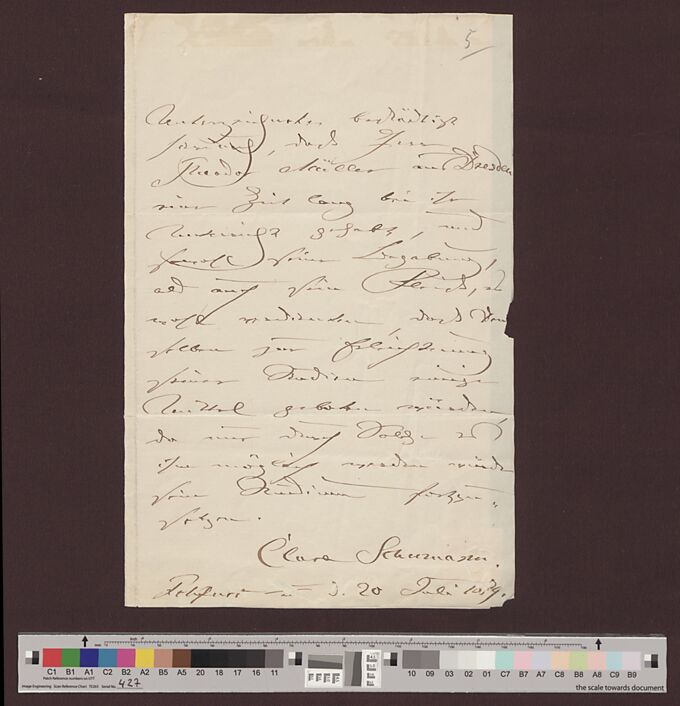
The situation was very different for Clara Wieck (1819–1896). As the daughter of a piano teacher and a singer/pianist, she was not raised exclusively for a married life, but was also trained to be a professional musician. In 1840, against the will of her father, she married Robert Schumann, who at the time was still largely unknown. Her composing soon fell by the wayside, even though her husband initially encouraged her to continue. In their joint diary, however, she expressed her cause for complaint: “I don’t get to play at all nowadays: partly my being unwell prevents it, partly Robert’s composing. If only it were possible to resolve the evil of the thin walls; I unlearn everything and because of that might become very melancholic.”12 Despite her numerous pregnancies and eight children, Clara Schumann continued her international career as a pianist, always also performing her husband’s works, thereby making them known.
… Professional Composers, Directors, Testamentary Executors, and Educators …
Gaelic Symphony, by the American composer Amy Beach (1867–1944), was the first symphony written by an American woman. Beach had been forced into a marriage arranged by her parents, and neither her husband nor her parents allowed her to perform. Not until her husband’s death in 1910 did she again go on concert tours. This obvious hindrance to her personal development prompted her to become an advocate for women’s rights.
Ethel Smyth (1858–1944), an English composer trained in Germany, was active in the women’s suffrage movement. Her The March of the Women (text: Cicely Hamilton) became a political hymn for the movement, still sung today at feminist events. Singing this march helped suffragette leader Emmeline Pankhurst (1858–1928) make it through sleepless nights during her hunger and thirst strikes in Holloway Prison.13 In addition to chamber music and choral pieces, Smyth also composed six operas, three of which premiered in Germany.
Emilie Mayer (1812–1883), a pharmacist’s daughter born in Friedland, enjoyed similar success after having studied with renowned composers. Her oeuvre includes chamber music as well as major works for orchestra that were performed frequently. During her lifetime, she received numerous honors and was celebrated as a “female Beethoven,” but after her death she sank into utter oblivion. Her life and works were rediscovered through the research of Dr. Almut Runge-Woll14 and since then have increasingly been performed.
Around 1870, female musicians and composers began organizing in professional networks. The Association of Women Musicians of Vienna, formed in 1886, succeeded in getting social security benefits paid to women working professionally as musicians and composers. Among the distinguished members of this club were the composers Mathilde Kralik (von Meyrswalden, 1857–1944) and Vilma (von) Webenau (1875–1953), presumably the first woman to have taken private lessons with Arnold Schönberg (1874–1951).15
The French composer Lili Boulanger (1893–1918) was also one of the first female professional composers in France. At only nineteen she was the first woman to win the Grand Prix de Rome of the Academy of Fine Arts in Paris in the “music” category. She signed a contract with the Ricordi music publisher and was financially independent. After her early death, her sister Nadia Boulanger (1887–1979), a composer, conductor, and pianist, managed her estate and often conducted performances of her works. Nadia Boulanger was also a sought-after educator who taught at many European and American institutions. Aaron Copland (1900–1990) and Marion Bauer (1882–1955) were among her students. She had her sister’s works released on records in the 1960s. The critics were delighted: “Let us hear more of her. Let us know what we have missed.”16
The research on women that came out of the student movement of the 1960s and ’70s has ensured that the unknown, disavowed, and thus unappreciated share of women in the history of music be made visible and can once again be experienced.
Written by:
Quote recommendation
Footnotes
- 1 Attributed to Paul the Apostle, 1 Corinthians 14:34 (NKJV).
- 2 Sigrid Nieberle, entry “Autorschaft” (Authorship) in Lexikon Musik und Gender, ed. Annette Kreutziger-Herr and Melanie Unseld (Kassel: Bärenreiter, 2010), 130ff.
- 3 Linda Maria Koldau, Frau—Musik—Kultur. Ein Handbuch zum deutschen Sprachgebiet der Frühen Neuzeit (Cologne and Vienna: Böhlau, 2005).
- 4 Letter 52 in The Letters of Hildegard von Bingen, vol. 1., ed. Joseph L. Baird, trans. Joseph L. Baird and Radd K. Ehrman (Oxford University Press, 1994), 3, 127.
- 5 Annette Kreutziger-Herr and Dorothea Redepenning, eds., Mittelalter-Sehnsucht? (Kiel: Wissenschaftlicher Verlag Vauk, 2000); Marianne Richert-Pfau and Stefan J. Morent, Hildegard von Bingen: Der Klang des Himmels (Cologne: Böhlau, 2005).
- 6 Jan Boeker, “Beatriz de Dia”: https://mugi.hfmt-hamburg.de/receive/mugi_person_00000185.
- 7 Christine Fischer, Instrumentierte Visionen weiblicher Macht (Kassel: Bärenreiter, 2007).
- 8 Eva Rieger, Nannerl Mozart. Das Leben einer Künstlerin im 18. Jahrhundert (Frankfurt: Insel-Verl., 1990).
- 9 Maria Hübner, ed., Anna Magdalena Bach. Ein Leben in Dokumenten und Bildern (Leipzig: Evangelische Verlagsanstalt, 2004).
- 10 Abraham Mendelssohn’s letter of November 15, 1805, to his mother-in-law Bella Salomon, cited in Sebastian Hensel, The Mendelssohn Family (1729–1847) from Letters and Journals, vol. 1, trans. Carl Klingemann (New York: Harper & Brothers, 1882), 73. See also R. Larry Todd, Fanny Hensel: The Other Mendelssohn (Oxford and New York: Oxford University Press, 2010), 15, 362.
- 11 Abraham Mendelssohn’s letter of July 16, 1820, to his daughter Fanny, cited in Hensel, The Mendelssohn Family, 82; Todd, Fanny Hensel, 28, 48.
- 12 Robert and Clara Schumann, The Marriage Diaries of Robert & Clara Schumann: From Their Wedding Day Through the Russia Trip, ed. Gerd Nauhaus, trans. Peter F. Ostwald (Boston: Northeastern University Press, 1993), 56. See also Beatrix Borchard, Clara Schumann. Ihr Leben. Eine biographische Montage (Hildesheim: Olms, 2015), 150–51.
- 13 See the letter from Emmeline Pankhurst to Ethel Smyth, April 9, 1913, in Ethyl Smyth, Female Pipings in Eden (London: P. Davies, 1934), 213.
- 14 Almut Runge-Woll, Die Komponistin Emilie Mayer (1812–1883). Studien zu Leben und Werk (Frankfurt a.M.: Peter Lang GmbH, Internationaler Verlag der Wissenschaften, 2003). Her life and work are presented in detail for the first time in the 2018 documentary film Komponistinnen (Women Composers) by Kyra Steckeweh and Tim van Beveren (Germany, 95 mins): https://www.youtube.com/watch?v=HsBbkqTTA9I (English trailer).
- 15 Susanne Wosnitzka, “‘Gemeinsame Not verstärkt den Willen’—Netzwerke von Musikerinnen in Wien,” in Musikerinnen und ihre Netzwerke im 19. Jahrhundert, ed. Annkatrin Babbe and Volker Timmermann, Series of the Sophie Drinker Institute, vol. 12 (Oldenburg: BIS-Verlag, 2016).
- 16 See Marc Blitzstein, “Music’s Other Boulanger,” in Saturday Review 43/22 (May 28, 1960): 60, cited in Léonie Rosenstiel, The Life and Works of Lili Boulanger (Cranbury, NJ: Associated University Presses, 1978), 215.


